Will AI Overviews Kill Your Small Business Website? An Honest Read From an SA Web Guy

Danny Tsui
TL;DR
- Probably not the way the LinkedIn posts say it will. For most local service businesses in San Antonio, AI Overviews barely show up on the searches that actually bring you customers.
- I ran 4 commercial HVAC queries in San Antonio last week. Google's AI Overview triggered on zero of them. The Map Pack and ads still owned the page.
- The real risk isn't AI stealing your clicks. It's AI answering for you while never mentioning your name. Different problem, different fix.
- Your website matters more now, not less. It's the thing AI reads to decide whether you exist.
- 5-minute self-check at the bottom, plus a free audit if you'd rather I run it.
The fear is reasonable. The headline is wrong.
Almost every week an owner sends me the same screenshot. Google search, big AI-written answer box sitting on top, no reason to click anything below it. Then the question: "Is this going to kill my website?"
I get it. You spent money on that site. If Google just answers the question itself, why would anyone visit?
Here's the honest version, from someone who builds these sites for a living and has been testing this for a year. AI Overviews are real, and they do change some things. But "AI Overviews are killing small business websites" is a headline written for clicks, not for the searches your customers actually run.
Let me show you what I'm seeing on the ground in San Antonio.
What AI Overviews actually do on local searches
An AI Overview is the AI-written summary Google sometimes drops at the top of the results page. It pulls from a handful of sources, writes a paragraph or two, and cites where it got the information.
The key word is *sometimes*. AI Overviews don't fire on every search. They fire on some, skip most.
In early June 2026 I ran four queries a real San Antonio customer would type: "best HVAC San Antonio," "AC repair San Antonio," "emergency HVAC near me," and "AC installation San Antonio." Google's AI Overview triggered on exactly none of them. What I got instead was the same layout you already know. Ads on top, the Map Pack with three local businesses, then the regular results.
That tracks with the broader data. The overall AI Overview trigger rate is high and climbing fast. Ahrefs clocked it near 48% of all queries by early 2026, up from about 35% a few months earlier. But high-intent local commercial searches are the exception. Those fire in the single digits, maybe up to 8%, because Google leans on the Map Pack instead. When someone is ready to call a plumber, an electrician, or an AC company, Google still serves the map and the ads, not an AI summary.
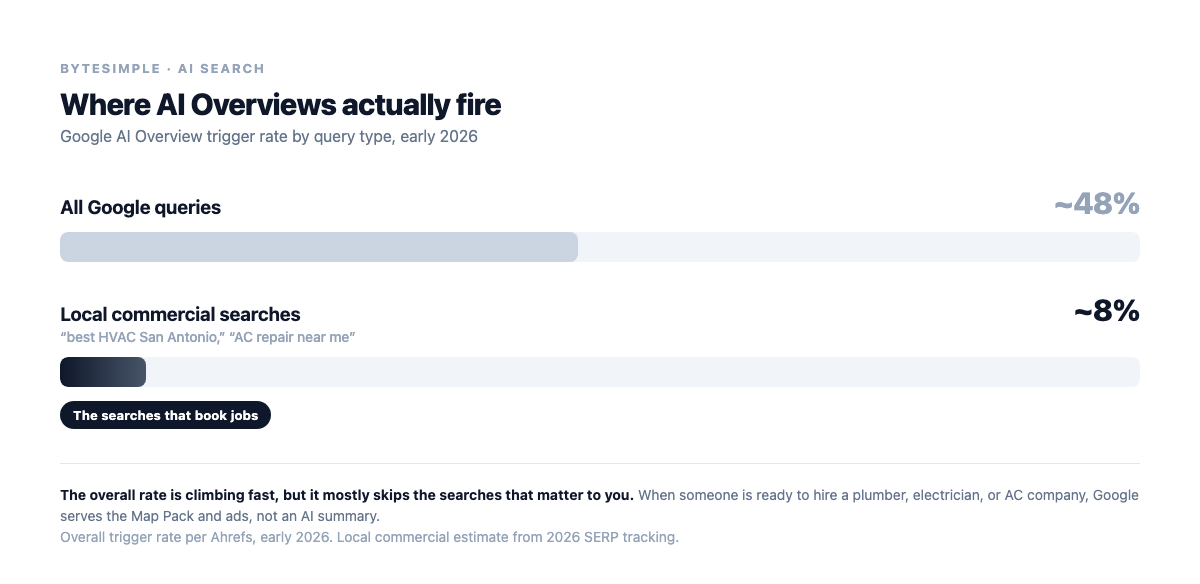
Why? Because those searches need a phone number and a "near me," not a paragraph explaining what HVAC means. Google knows that.
Where AI Overviews actually do show up
AI Overviews love informational questions. "How often should I service my AC." "Why is my electricity bill so high in summer." "What size water heater do I need." Those are the searches where Google feels safe writing the answer itself.
And yes, on those searches, the click-through to your blog post can drop. If you wrote a 1,500-word article on "how often to replace an AC filter" and Google now answers it in three sentences up top, fewer people click through. That part is real.
But ask yourself what those clicks were ever worth. Someone googling "how often to replace an AC filter" is mostly looking for a free answer, not a $6,000 install. The informational traffic AI Overviews skim off the top is the least valuable traffic you had. The ready-to-buy searches, the ones with money behind them, mostly still land on the classic layout.
So the picture isn't "AI is killing your website." It's "AI is eating some of your lowest-value traffic, and largely ignoring your highest-value traffic." Those are two different stories.
The real risk nobody puts in the headline
Here's the part that actually should worry you, and it's not the one you've been reading about.
The risk isn't AI Overviews taking your clicks. It's AI answering the question while never saying your name.
When an AI Overview does fire, it names a few businesses and cites a few sources. If you're one of them, you just got introduced to a customer for free. If you're not, you're invisible in that moment, and so is your website, no matter how nice it looks.
This is the shift that matters. For fifteen years, SEO was about ranking your page on a list. Now there's a second game on top of it: getting your business *named inside the answer*. Showing up on the list and getting named in the AI summary are related, but they're not the same thing. I wrote a full breakdown of how to check whether AI is naming your business, with a 5-minute DIY walkthrough, here: How to check if your business shows up in ChatGPT.
The businesses that lose in the AI era won't be the ones whose blog traffic dipped. They'll be the ones AI never mentions, on Google or ChatGPT or anywhere else, because they were never built to be readable by a machine in the first place.
Why your website matters more now, not less
This is the part that surprises people.
If anything, AI raises the stakes on your website. Here's why. AI doesn't invent its answer out of thin air. It reads the web and repeats what it finds. Your website is one of the main things it reads to decide what your business does, where you do it, and whether you're worth recommending.
A thin, five-page site with no real content gives AI almost nothing to work with. So it guesses, or it skips you and names a competitor with a deeper, clearer, better-structured site. The site isn't just a brochure anymore. It's the source material.
That means the fundamentals didn't change. They got more important:
- Real content depth. Service pages that actually explain the service. Neighborhood pages for the areas you cover, Stone Oak, Alamo Heights, Helotes, Boerne. FAQ sections that answer what customers actually ask.
- Structured data. Schema markup that spells out, in machine-readable form, that you're a local business, what you offer, and where. Most small business sites have none of it. That's a free advantage sitting on the table.
- Reviews and authority. AI weights reviews and third-party mentions heavily when it decides who to name. A site with 30 reviews and zero press is a hard sell to an algorithm.
None of that is new SEO advice. AI just turned up the volume on it.
So, do you still need a website in 2026? Yes.
I'll say it plainly, even though I build websites and you can roll your eyes at the source. Yes, you still need one, and you need it to be good.
Not because of vanity. Because the website is now the thing that feeds every surface a customer might find you on. Google's regular results, the Map Pack, the AI Overview when it fires, ChatGPT, Perplexity. They all read from the same place. Starve that source and you go quiet everywhere at once.
The owners getting hurt right now aren't the ones with great websites. They're the ones who treated the website as a digital business card, never added a page after launch, and are now invisible to a machine that decides recommendations by reading the web. The fix isn't panic. It's depth.
A 5-minute self-check
Want to see where you actually stand? Three browser tabs, five minutes.
- Google, incognito window. Run the searches a customer would use to find you. "best [your service] [your city]," "[your service] near me." Does an AI Overview even appear? On most local commercial searches in San Antonio, it won't. Note which businesses own the Map Pack.
- Now run an informational version. "how to [common question in your trade]." This is where an AI Overview is more likely to fire. When it does, read the citations. Are you in there? Who is?
- ChatGPT, search toggle on. Ask "who are the best [your service] companies in [your city]." See whether your name comes up and what sources it cites.
If you're getting named, good, you've got baseline visibility most local businesses don't have. If you're not, the citations show you exactly where the authority lives in your market, which is the map for fixing it.
I broke down that full walkthrough, with what a healthy result looks like and the four reasons most sites come up empty, in the ChatGPT visibility post. And if you want the bigger-picture take on whether any of this replaces SEO, I wrote Will AI Replace SEO? 12 Months of Watching It Happen.
Want me to run the check for you?
If you'd rather skip the DIY, I'll run it by hand and send you a clean 1-page report. Screenshots from Google, ChatGPT, and Perplexity for your business, a breakdown of where AI is pulling its answers in your market, and the three highest-impact fixes for your specific gaps.
No tool, no signup spam, no upsell sequence. I run it myself and email the PDF back.