Will AI Replace SEO? 12 Months of Watching It Happen

Danny Tsui
TL;DR
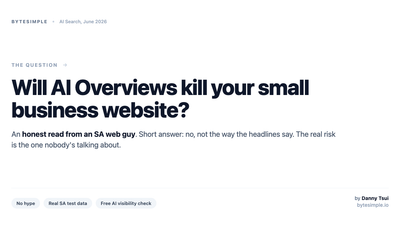
- No, AI is not replacing SEO. But it is rewriting which parts of SEO actually matter for a local small business.
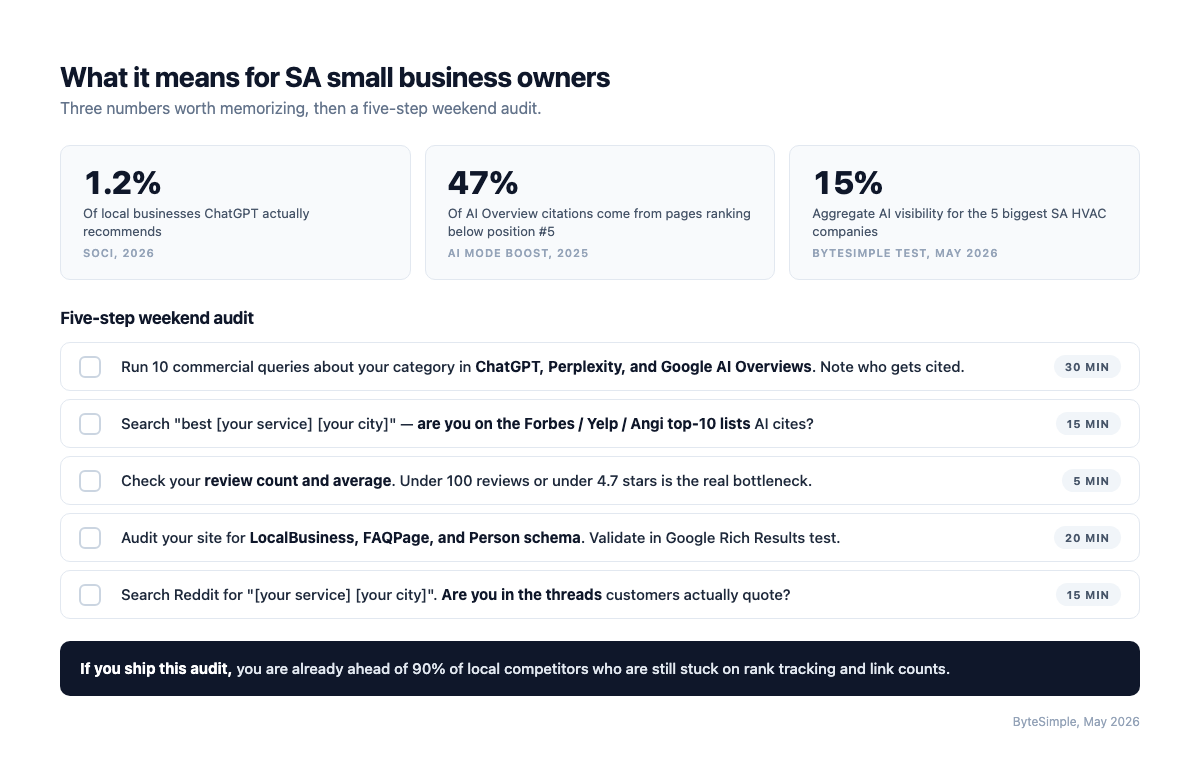
- AI Overview trigger rates on local commercial queries are volatile (industry estimates range from 7% to 25% depending on the source and month). I ran 4 in San Antonio last week and got zero AIOs. ChatGPT recommends just 1.2% of all local business locations per SOCi's 2026 Local Visibility Index. Most of your customers are still on plain Google.
- When AI does cite a local business, the source mix is broader than you'd expect: Forbes lists, Yelp top 10s, Reddit threads, the company's own blog, and pages that rank below position #5. Page rank #1 isn't a free pass.
- I just ran a 60 query test on the 5 biggest HVAC companies in San Antonio. Combined, they showed up in 15% of AI results. Two of them scored zero. That is the real opportunity, not the panic story.
- If you're running a local service business, your job in 2026 is to show up in the places AI cites. Same SEO discipline. Slightly different surface area.
The short answer
I get this question almost every week. Owner of a small business reads a LinkedIn post about ChatGPT killing search, then asks if SEO is dead.
Here's the short answer. SEO is not dead. The pages, citations, reviews, and links that rank you on Google are the same pages, citations, reviews, and links that get you cited by ChatGPT, Perplexity, and Google's AI Overviews.
What's actually changed is the surface where the answer shows up. The work hasn't.
I've spent the last 12 months running tests on this for my own clients and writing about what I've found. This is the post I wish I had a year ago.
What 12 months of watching actually showed me
1. AI search exists, but most local queries don't trigger it
I ran 4 commercial queries about HVAC in San Antonio last week ("best HVAC San Antonio," "AC repair San Antonio," "emergency HVAC near me," "AC installation San Antonio"). Google AI Overviews triggered on zero of them. The Map Pack and sponsored ads still owned the page.
Aggregate industry data on AIO trigger rate is messy. Estimates range from 7% (Ahrefs, early 2026) to 24% peak (Semrush tracking) to 68% in some industry verticals (ALM Corp). The volatility is the story, not any single average. Most of your customers are still landing on the classic Google layout: ads on top, map pack, ten organic results.
If you're chasing high commercial intent local keywords, plain old Google is still where the sale starts.
2. AI doesn't always cite who ranks first
ChatGPT and Perplexity don't make up answers from thin air. They cite sources. But not in the way most agencies pitch it.
The latest data (AI Mode Boost 2025) puts it like this: 47% of AI Overview citations come from pages ranking below position #5. Page-level rankings matter less than people think. The well structured page that ranks #8 can beat the bloated page that ranks #2. About 92% of AI Overviews still cite at least one top 10 domain, so site authority compounds. But the specific page that gets cited isn't always the page that ranks first.
So if your "AI strategy" doesn't include the basics (technical SEO, useful content, a clean schema layer, real review velocity, local citations), you don't have an AI strategy. You have a panic.
3. AI cites the kinds of sources you'd expect
When AI does cite a local business, it almost never finds them through some clever crawling of the business's own site. It finds them through:
- Forbes and US News "best of" lists
- Yelp top 10 articles
- Reddit threads where customers actually talk
- Local news (in San Antonio, that's MySA, KSAT, Express News)
- Listicle blog posts on competitor sites and local directories
- The company's own blog or service page when it has actual answers
In the SA HVAC test, ChatGPT cited Forbes 5 separate times across the 4 queries. Yelp top 10 came up almost as often. Two companies got cited because their own emergency service page was structured well enough for the AI to extract from.
That's the playbook. Get into Forbes lists, Yelp top 10s, MySA, and your own blog. Same SEO discipline. New target list.
4. The companies "winning" SEO are mostly invisible to ChatGPT
This is the part that surprised me most.
I tested the 5 biggest HVAC names in San Antonio. The kind of brands you'd expect to see everywhere. Combined, across ChatGPT, Perplexity, and Google AI Overviews, they showed up in 9 out of 60 possible spots. That's 15%.
Two of them scored zero. The brand with the most reviews in the city scored 33%, and that was the high.
One company in particular runs a "Best HVAC in San Antonio" listicle that ranks number 1 on Google for the head keyword. Everyone clicks it. AI cited it zero times. The listicle drives traffic but doesn't transfer to AI authority. If you'd told me 18 months ago that the top organic listicle wouldn't translate to ChatGPT citations, I wouldn't have believed it.
The takeaway: there's a real visibility gap between Google rankings and AI rankings, and almost nobody is closing it intentionally.
The honest reframe: AI changes SEO, it doesn't replace it
Every agency post on this topic gives you the same three sentences. "No, AI won't replace SEO. SEO is more important than ever. Schedule a free consultation."
I'll do you the courtesy of being more useful than that.
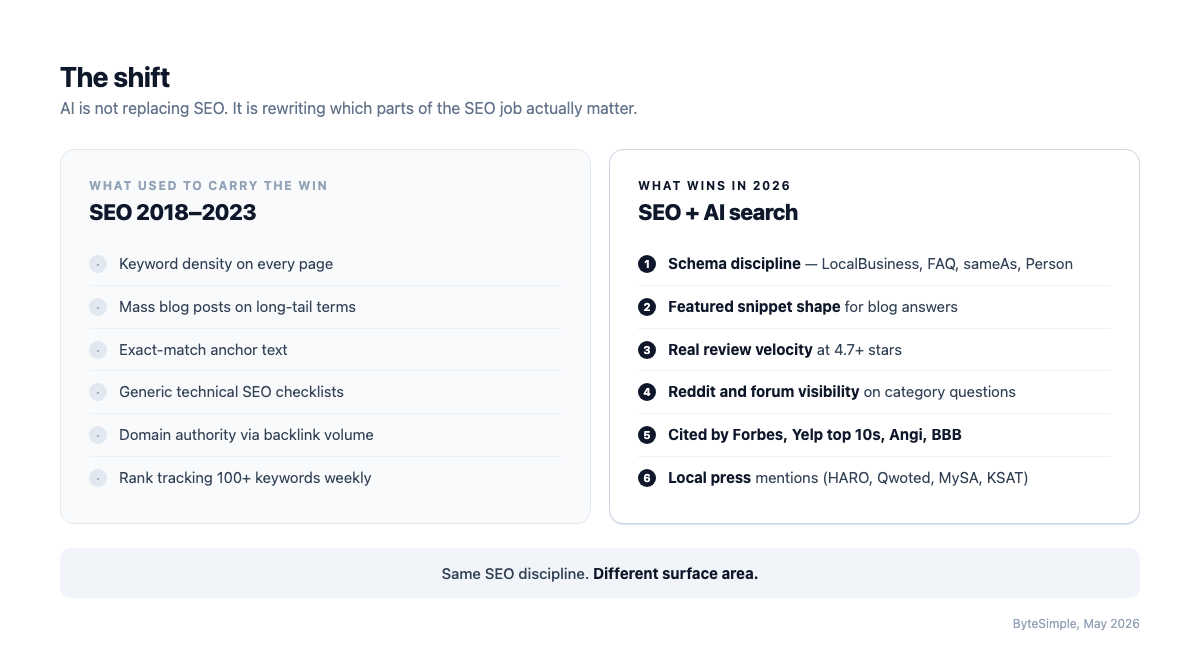
Here's what's actually true. AI is changing five things about the SEO job:
1. Click through rates on informational queries are dropping. If someone asks Google "what is BTU sizing for HVAC," they get the answer above the fold and never click. Informational keywords are losing traffic. Commercial and local keywords are mostly fine.
2. Featured snippet answers got more important, not less. Whatever Google pulls into AI Overviews is usually pulled from a top featured snippet candidate. Optimizing for snippets used to be nice. Now it's how you get cited.
3. Schema markup matters more. AI engines parse structured data to understand who you are, what you do, and where. If your site doesn't have LocalBusiness, Organization, FAQPage, and Person schema (for the owner), you're handing the AI a guess instead of a fact.
4. Reviews became part of the answer, not just part of the ranking. ChatGPT will read your reviews when it answers questions about you. So will Perplexity. So will Google. A 4.9 star average with detailed reviews now feeds the AI's words about your business.
5. Local citations and earned media compound differently. Getting on a Forbes list, a Yelp top 10, a MySA roundup, or a niche industry listicle now pays a second time when AI cites it. The same pickup that helped your local SEO last year now also helps your AI visibility.
That's the work. Not "AI is killing SEO." Not "rank in ChatGPT with this one trick." It's the same fundamentals with sharper aim.
What actually moves AI visibility (real test data)
I'll save you the listicle of 47 tactics you'll never get to. Here's the short list of what actually moved the needle for clients I work with.
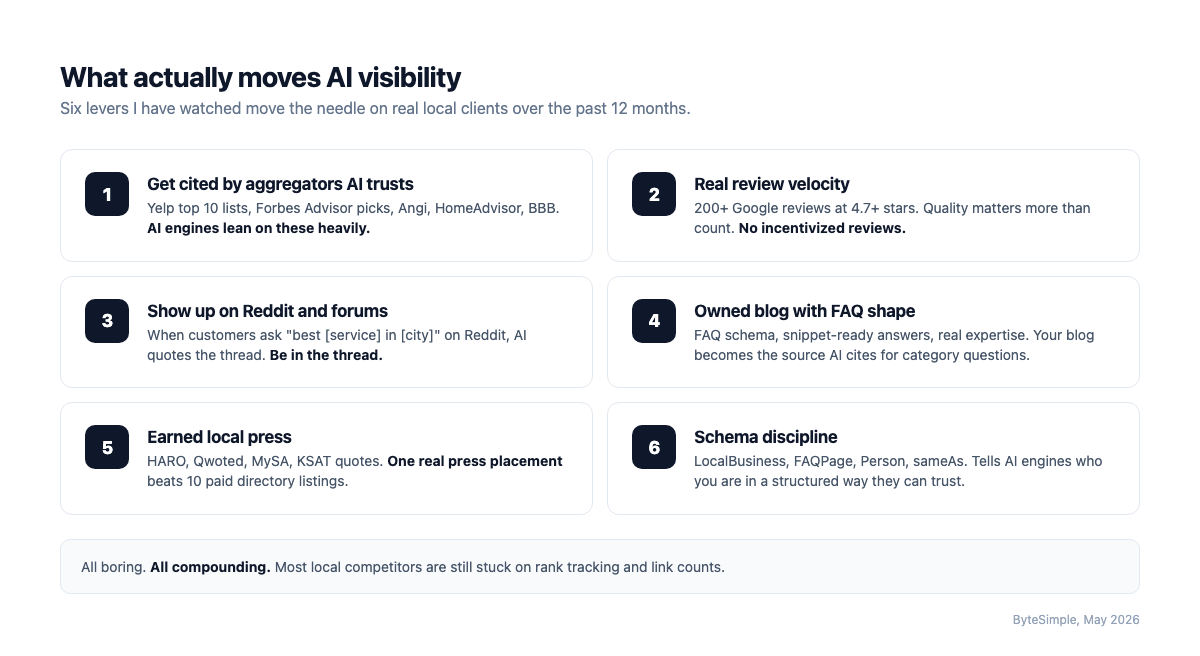
Get top 10 placements in Forbes, Yelp, US News, BBB, and other authority lists. This is a slow earned media play, not a directory submission. HARO and Qwoted are useful here. So is local press in your city.
Build out a real schema layer. LocalBusiness with proper hours, service areas, services, and aggregateRating. Person schema for the owner with sameAs links to LinkedIn and the founder's profiles. FAQPage on every service page. The AI engines parse this and use it.
Publish content that answers the actual questions buyers ask. Not blog posts written for keywords. Posts written for questions. "How much does HVAC installation cost in San Antonio in 2026" is a real question. "AC Repair Services San Antonio" is keyword stuffing.
Get more reviews, and more detailed ones. AI engines weight review depth. A 4.9 with 30 detailed reviews beats a 4.9 with 300 one liners.
Mention the city, neighborhood, and service area in body content. Not just in the title tag. AI engines extract entities. They're better at it when entities are surrounded by context, not crammed into a meta tag.
Show up on Reddit, in the right way. When AI surfaces "what's the best HVAC company in San Antonio," it sometimes pulls from Reddit threads. Don't astroturf. Do answer questions in your subreddit honestly when you have something useful to add.
That's the entire AI SEO playbook for 2026. Everything else is a nice to have.
What this means if you're a small business owner in SA
If you're a local service business in San Antonio, here's the honest read.
You don't need to panic about AI. You're already not ranking in AI. Most of your competitors aren't either. There's a window of maybe 12 to 18 months before this market gets crowded the way Google did.
What you do need to do is stop treating AI as a separate game. The agency that pitches you "AI SEO" as a $1,500 add on to your regular SEO is selling you the same work twice.
The companies that show up in ChatGPT for "best HVAC in San Antonio" two years from now will be the ones that did real local SEO this year. Reviews, schema, local press, useful content, a clean site. That's it.
If your current "SEO provider" can't tell you whether your site has LocalBusiness schema, whether your blog answers real customer questions, or whether you've been picked up by any local press, that's the conversation to have. Not "are we AI ready."
Quick gut check
If you've read this far, here's the test. Go open ChatGPT right now, switch on search mode, and type "best [your category] in [your city]." See what comes up. Write down whether your business is in the answer, and what sources got cited.
That's your starting point. If you're in there, the work is to stay there. If you're not, the work is to get into the sources that are.
Either way, the work is SEO. Same as it's always been.
If you want a hand running that test, or want me to look at why your business isn't showing up, you know where to find me.
See if your business shows up in ChatGPT
If you're running a home services business and you've never tested what AI says about you, here's an easy way to find out. I run a free AI Visibility Check by hand for HVAC, plumbing, electrical, and roofing owners. ChatGPT, Perplexity, Google AI Overviews, and Bing Copilot, all queried with what your customer would actually ask. PDF back in your inbox within 48 hours.
No automated dashboard, no signup tax, no upsell sequence. Get your free AI Visibility Check and see exactly where you stand.