How San Antonio Small Businesses Are Actually Using AI in 2026

Danny Tsui
TL;DR
- Most of the AI hype aimed at small business owners is noise. The real uses are smaller, more boring, and more useful than the headlines.
- The owners getting value aren't building anything. They're using AI to write the stuff they hate writing, answer customers faster, and finally keep up with content.
- A San Antonio HVAC company I work with uses it to turn a tech's two-line job note into a clean customer follow-up. That's the actual frontier for most of us.
- The ones getting burned are treating AI as a strategy instead of a tool, or trusting it with things it gets confidently wrong.
- Below: the real use cases I see on the ground, what's not working, and how to start without wasting a Saturday.
The honest state of small business AI
I do web and marketing work for local businesses in San Antonio, so I get a front-row seat to how owners actually use AI, not how the LinkedIn posts say they should.
Here's the honest version. Almost nobody I work with is doing anything fancy. No custom agents, no automation empires, no "AI-first" anything. What they're doing is quieter. They're using a chatbot to get through the parts of the week they used to dread, and getting a few hours back.
That's not a letdown. That's the whole point. The owners winning with AI in 2026 treat it like a sharp intern who works for pennies and never sleeps. Not a genius, not a strategy, just useful.
Let me walk through what that actually looks like.
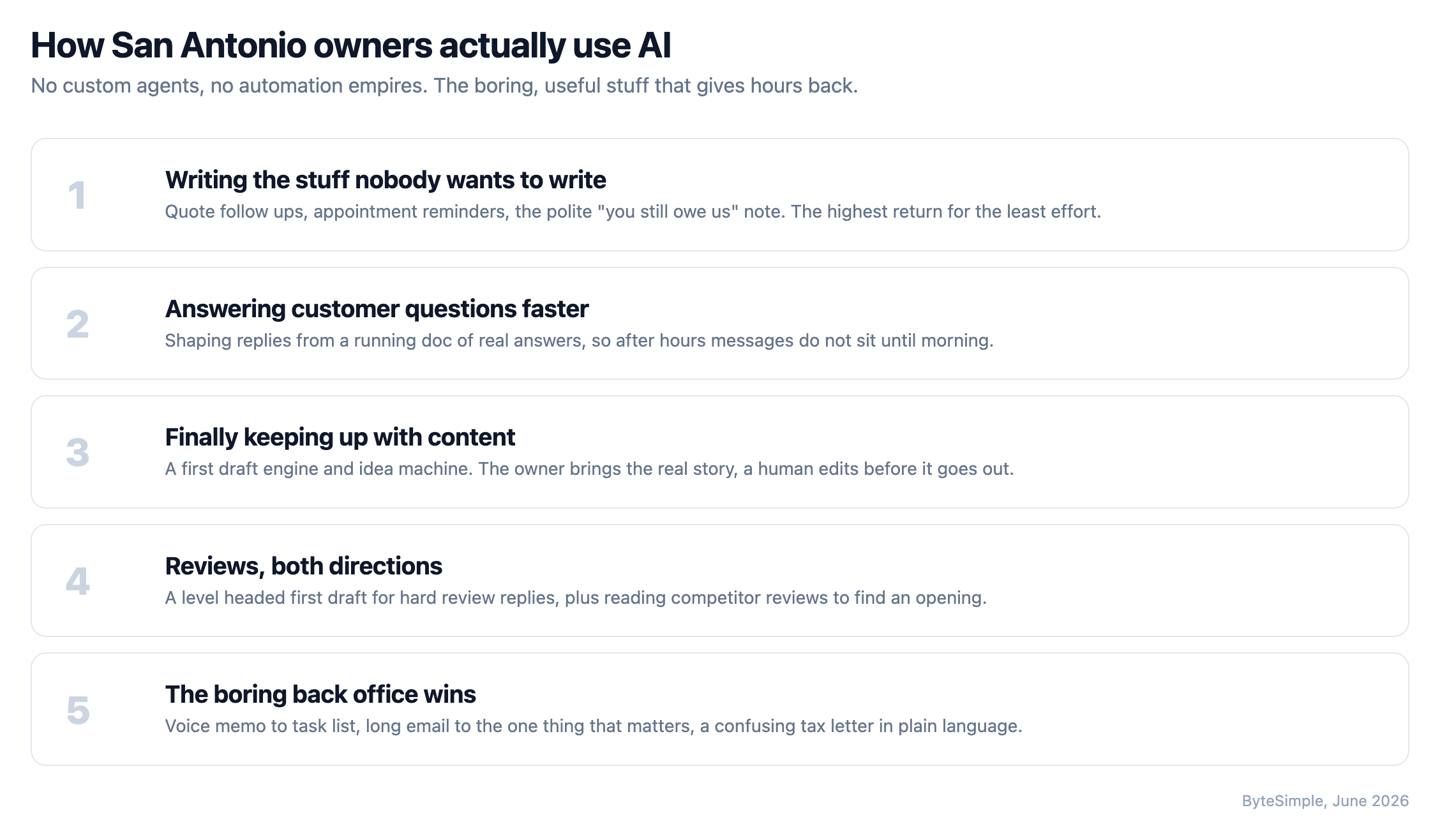
1. Writing the stuff nobody wants to write
This is the big one. It's not glamorous and it's where most of the real value lives.
Quote follow-ups. Appointment reminders. The "sorry we missed you" text. The estimate cover note. The polite version of "you still owe us for the last job." Every local business has a pile of small writing tasks that pile up because they're tedious, not hard.
A San Antonio HVAC company I work with had a habit of letting quotes go cold because writing the follow-up felt like a chore. Now a tech types two lines into a notes field, and AI turns it into a clean, friendly follow-up the office can send in ten seconds. Their quote-to-booking rate moved, not because the AI is smart, but because the follow-up actually goes out now.
If you do nothing else with AI this year, point it at the writing you keep avoiding. That's the highest return for the least effort.
2. Answering customer questions faster
The second real use is internal speed.
A customer asks a question the owner has answered a hundred times. "Do you service Stone Oak?" "How much is a tune-up?" "Can you come out on a Saturday?" Instead of writing it fresh again, owners are keeping a running doc of their real answers and having AI shape each reply to fit the specific message.
A few are going further and using AI to draft first-pass responses to the after-hours messages that used to sit until morning. The owner still reads and sends. The AI just removes the blank-page delay.
The trick most people miss: AI is only as good as what you feed it. Give it your real prices, your real service area, your real policies, and it's useful. Let it guess, and it'll invent a Saturday rate you never set. More on that failure mode below.
3. Finally keeping up with content
Every local business owner knows they should be posting. Almost none of them have the time. This is the gap AI quietly closed in the last year.
Not "AI writes your blog and you publish it." That goes badly, and I've written about why AI-generated content alone doesn't get you found. What works is using AI as a first-draft engine and an idea machine. Turn one job into a "here's what we found and how we fixed it" post. Turn a seasonal pattern into a "get ready for August" tip. The owner brings the real story and the local detail. The AI handles the structure and the blank page.
The businesses doing this well still sound like themselves, because a human edits every piece before it goes out. The ones doing it badly publish raw AI text, and it reads exactly like raw AI text. Customers can tell. So can Google.
4. Reviews, both directions
Two uses here, both practical.
Responding to reviews. Owners are drafting replies to Google reviews with AI, especially the hard ones. A calm, professional response to an angry one-star is hard to write when you're annoyed. AI gives you a level-headed first draft you can soften and send. That matters more than people think, because review responses are a ranking and trust signal, not just damage control.
Reading the market. Some owners are pasting their competitors' reviews into a chatbot and asking what customers keep complaining about. It's a cheap way to find an opening. If three HVAC companies near you keep getting dinged for no-show appointments, "we show up when we say we will" just became your headline.
5. The boring back-office wins
The least exciting category, and a real one.
Turning a messy voice memo into a clean task list. Summarizing a long supplier email into the one thing that matters. Drafting a job description. Cleaning up a spreadsheet formula nobody remembers how to write. Explaining a confusing insurance or tax letter in plain language before you call your accountant.
None of this shows up in a case study. All of it saves an owner twenty minutes here and there, which across a week is real time back.
Where small businesses are getting burned
I'd be doing you a disservice if I only listed the wins. Here's where I watch owners get hurt.
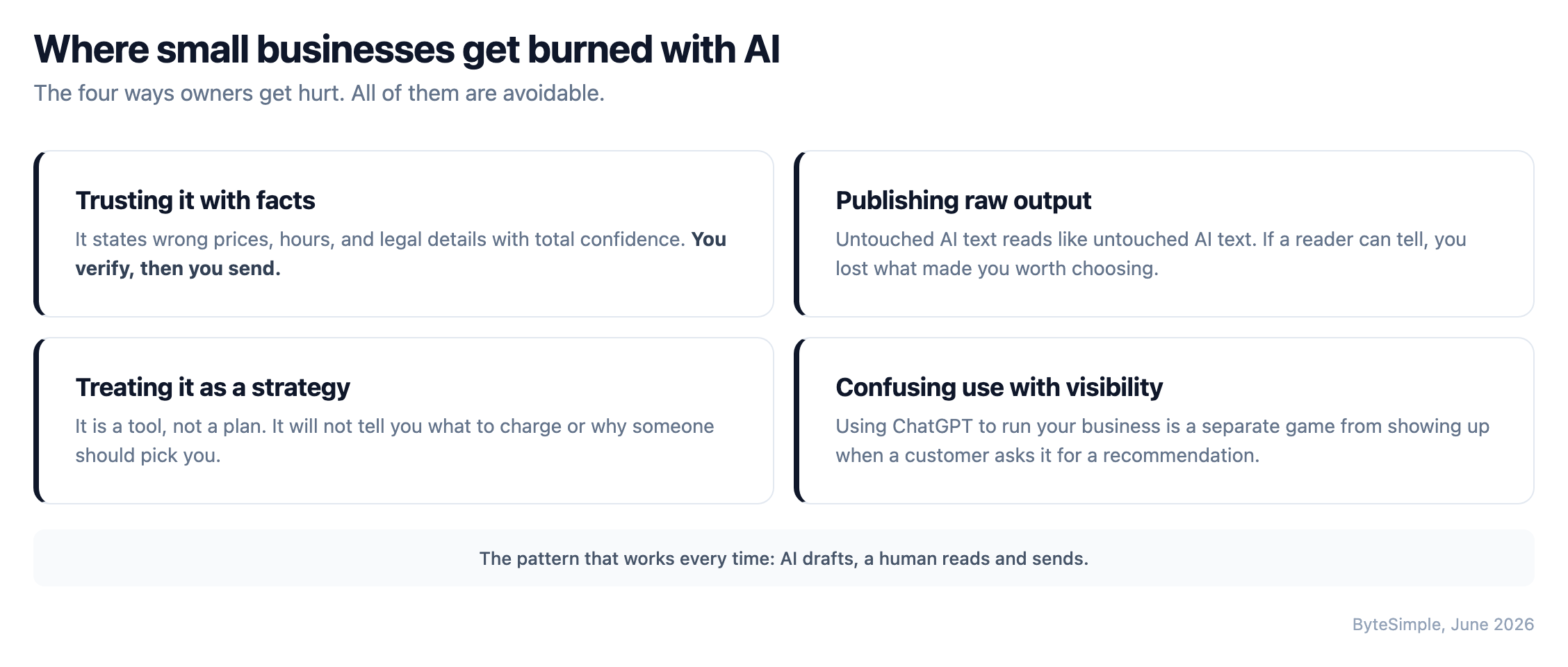
Trusting it with facts. AI states wrong things with total confidence. Prices, hours, legal details, "is this code-compliant" questions. It will give you a clean, wrong answer and never flinch. Never let it be the final word on anything a customer relies on or anything with money or liability attached. You verify, then you send.
Publishing raw output. The fastest way to look generic is to post AI text untouched. It's the same reason a website built on a generic template blends into every other one. If a reader can tell a machine wrote it, you've lost the thing that made you worth choosing.
Treating it as a strategy. AI is a tool, not a plan. It won't tell you which customers are worth chasing, what to charge, or why someone should pick you over the company down the road. Owners who expect AI to hand them a business strategy end up with a lot of polished output and no direction.
Confusing AI use with AI visibility. Using ChatGPT to run your business is a completely separate thing from showing up when a customer asks ChatGPT to recommend a business like yours. That second one is its own game. I broke it down in how to check if your business shows up in ChatGPT and whether AI Overviews are killing small business websites.
How to start without wasting a Saturday
You don't need a plan, a subscription stack, or a course. Start here.
- Pick the task you avoid most. The follow-up, the review reply, the post you never write. One task.
- Feed it your real information. Your actual prices, service area, and voice. The more real input, the better the output.
- Edit before it goes out, every time. Treat the AI draft as a starting point, never the final word. You're the editor.
- Add a second task once the first is a habit. Don't try to AI your whole business in a weekend. Stack small wins.
That's it. The owners getting value in 2026 didn't overhaul anything. They picked one annoying task, handed it to a tool, and kept the time.
Want to know where you actually stand?
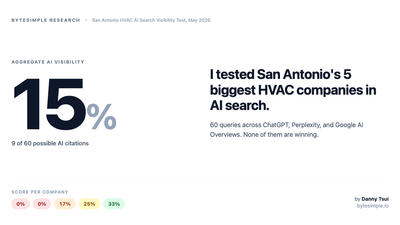
Curious whether AI is naming your business when local customers ask for a recommendation? I run a free, by-hand AI Visibility Check. Screenshots from ChatGPT, Perplexity, and Google for your business, where the AI is pulling its answers in your market, and the three highest-impact fixes for your gaps.
No tool, no signup spam, no upsell. I run it myself and email the PDF back.