What is GEO? A Plain English Guide for Local Business

Danny Tsui
Your Customers Are Asking AI Instead of Google
Here's something that probably happened this week: someone in your city pulled up ChatGPT or tapped the Google search bar and got an AI generated answer instead of a list of links. No scrolling. No clicking. Just an answer, right there.
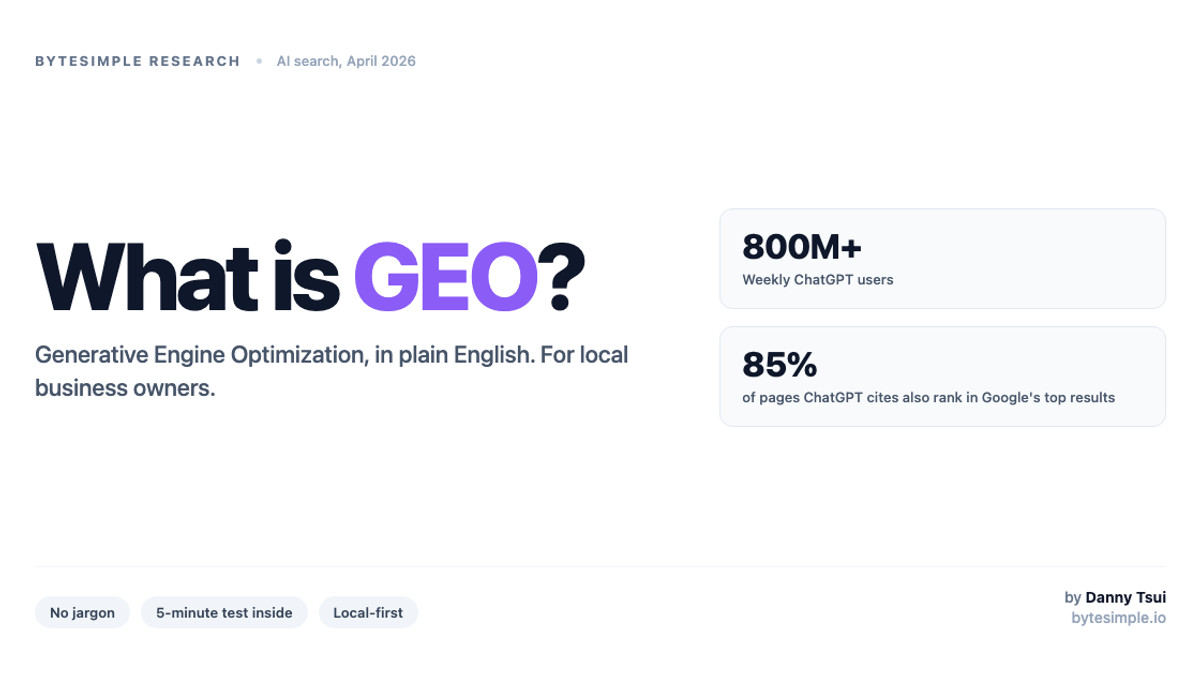
That shift is already changing how local businesses get found online. ChatGPT has over 800 million weekly users. Google's AI Overviews now show up in roughly 60% of searches. And about 60% of people never even click a link anymore. They read the AI summary and move on.
If your business isn't part of that answer, you're invisible to a growing chunk of potential customers.
That's where generative engine optimization comes in. And no, it's not as complicated as it sounds.
So What is Generative Engine Optimization?
Generative engine optimization (GEO) is the practice of making your business easier for AI tools to find, understand, and recommend.
Think about traditional SEO for a second. You optimize your website so Google ranks you on page one. Someone types "best HVAC company in San Antonio," sees your listing, clicks through, and calls you. That still works. It still matters.
GEO is different. Instead of ranking on a list, you're trying to be part of the answer itself. When someone asks ChatGPT or Google's AI Overview that same question, the AI pulls information from across the web, puts it together, and responds with something like: "A few trusted local HVAC shops in San Antonio serve residential and commercial systems across the area." It might never link to your site. But your name is in the answer.
Getting quoted vs. getting clicked. That's the shift.
How GEO is Different from Regular SEO
GEO doesn't replace SEO. They work together. Think of it this way:
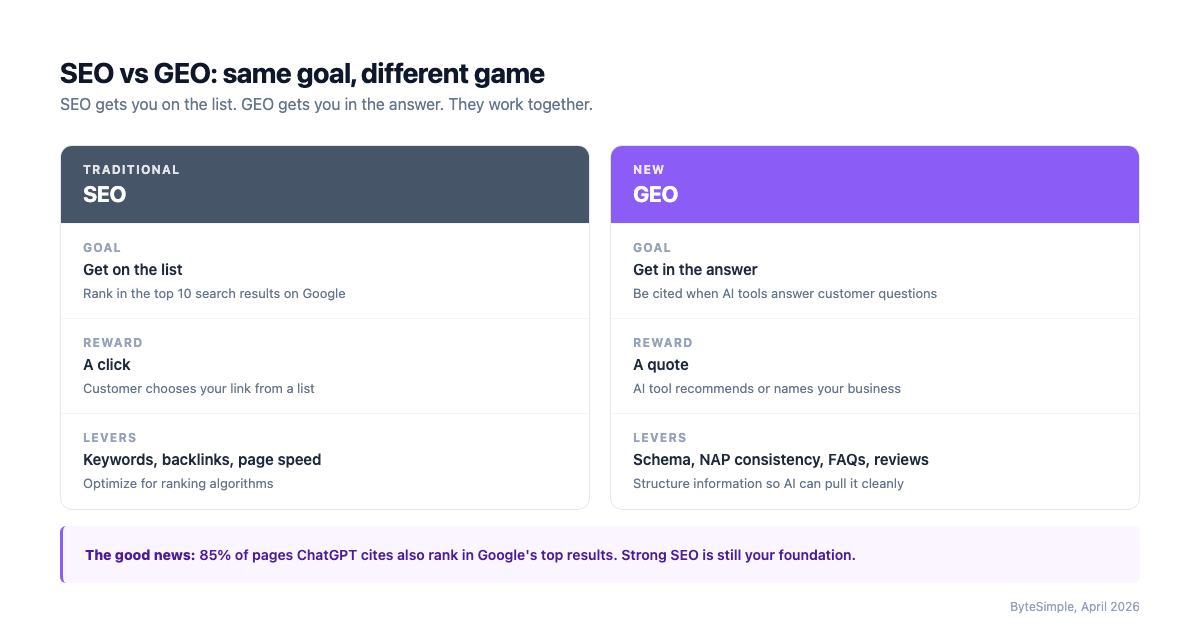
SEO gets you on the list. You optimize for keywords, build backlinks, and climb the rankings so people can find and click your website.
GEO gets you in the answer. You structure your content so AI tools can pull accurate information about your business and cite you when someone asks a relevant question.
Here's the good news: 85% of pages that ChatGPT cites also rank in Google's top results. So if you're already doing solid SEO work, you're building a foundation for GEO whether you realize it or not.
The difference is how you structure and present your information. AI tools don't read your website the way a person does. They scan for clear, structured, factual content they can pull into a response. If your site is a wall of marketing fluff with no real information, AI skips right over you.
Why This Matters If You Run a Local Business
You might be thinking: "I run a hat bar (or an HVAC company, or a chiropractic clinic). Do I really need to think about this?"
Short answer: yes, but not in the way you'd expect.
Here's a real scenario. Someone visiting San Antonio opens ChatGPT and types: "fun things to do near my hotel this weekend." If your business has clear, structured content about what you offer, where you're located, and what makes you different, there's a real chance you show up in that answer. If your website is vague or outdated, you won't.
Local businesses actually have an advantage here. National brands are fighting over broad terms. You can own the specific, local questions that your actual customers ask. "Best AC repair in Stone Oak." "Custom hat bar in San Antonio." "Chiropractor near Medical Center." These are the kinds of queries where a well optimized local business beats a big brand.
The window is open right now. Most local businesses haven't even heard of GEO. The ones who get their content structured early will be the default answers for years.
What Actually Makes AI Cite Your Business
AI tools don't just pick businesses at random. They look for specific signals. Here's what matters:
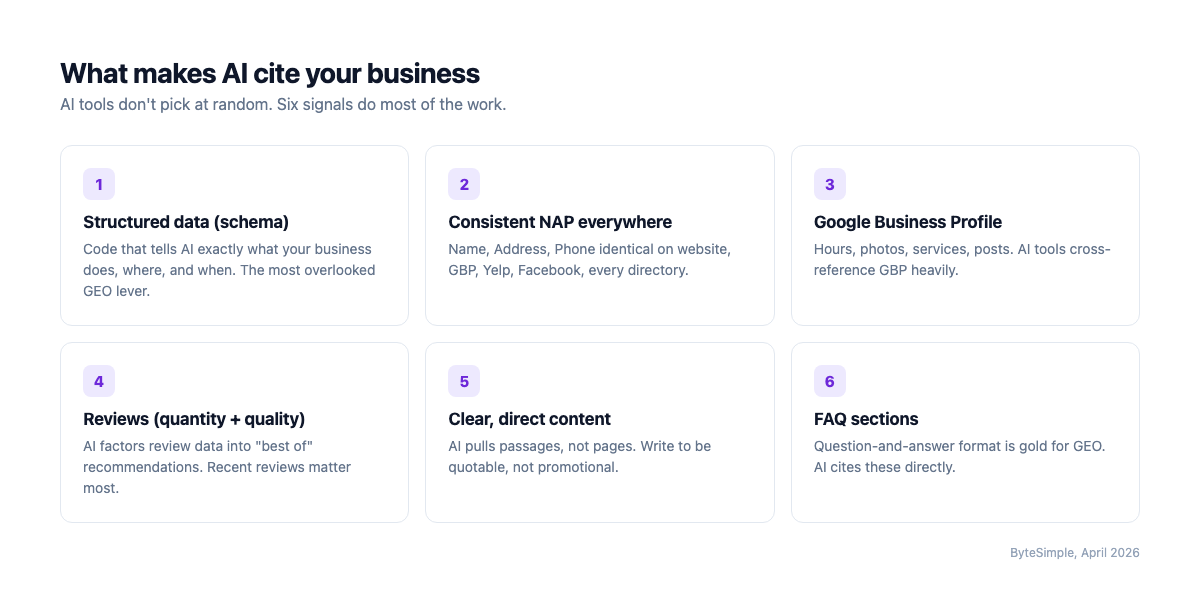
Structured data (schema markup). This is code on your website that tells AI tools exactly what your business is, where it's located, what you offer, and when you're open. I recently added LocalBusiness schema to a client's retail page. It includes their address, hours, phone number, star rating, and the shopping center they operate inside. That's the kind of structured, machine readable information AI tools love.
Consistent business information everywhere. Your name, address, and phone number need to match across your website, Google Business Profile, Yelp, Facebook, and every directory you're listed on. AI tools cross reference these sources. If your info is inconsistent, you look less trustworthy.
Google Business Profile. Still one of the most important things you can do. Keep it updated with current hours, photos, services, and posts. AI tools pull heavily from GBP data for local queries.
Reviews. Quantity and quality both matter. AI tools factor in review data when deciding which businesses to recommend. A business with 500 five star reviews is more likely to get cited than one with 12.
Clear, direct content on your website. AI pulls individual passages, not entire pages. If someone asks "what is a hat bar," your website needs a clear, concise paragraph that directly answers that question. Not a poetic marketing paragraph. A real answer.
FAQ sections. These are gold for GEO. When you have a question and answer section on your page, you're basically formatting content ahead of time in the exact structure AI tools are looking for. Pair it with FAQ schema markup and you're giving AI everything it needs on a silver platter.
Five Things You Can Do This Week
You don't need to hire a GEO agency or buy a new tool. Here are five things you can do right now:
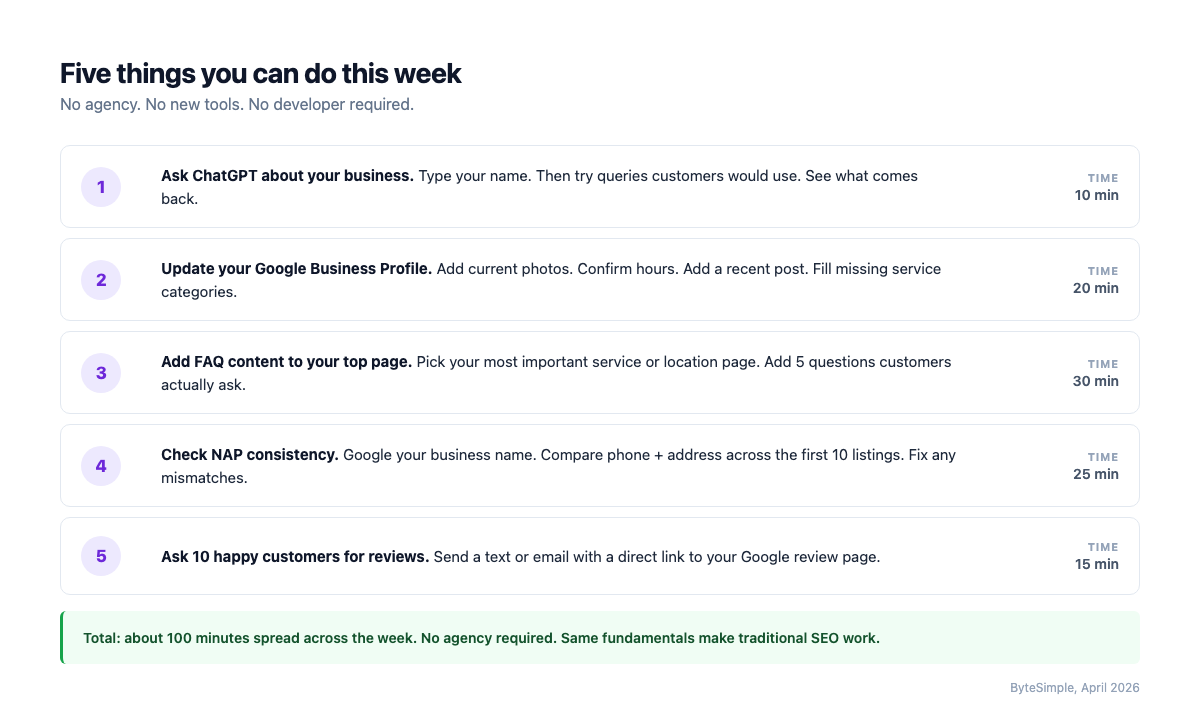
1. Ask ChatGPT about your business. Open ChatGPT and type your business name. Then try questions your customers would ask, like "best [your service] in [your city]." See what comes back. That's your baseline.
2. Update your Google Business Profile. Add current photos. Make sure your hours are right. Write a business description that clearly states what you do, where you are, and who you serve. Post something this week.
3. Add FAQ content to your key pages. Pick your most important service page or location page. Add 5-6 real questions your customers ask, with clear, direct answers. No fluff.
4. Check your NAP consistency. Google your business name and look at your listings across directories. Is your business name, address, and phone number exactly the same everywhere? Fix any mismatches.
5. Ask for reviews. Send a text or email to your last 10 happy customers with a direct link to your Google review page. More reviews = more trust signals for both Google and AI tools.
None of this requires a developer or a marketing degree. It's the same stuff that makes traditional SEO work, just done with a little more intention.
What You Don't Need to Worry About Yet
There's a lot of noise out there about GEO. Let me cut through some of it.
You don't need a "GEO agency." If someone is trying to sell you a separate GEO package on top of your existing SEO work, be skeptical. Good SEO and GEO overlap by about 85%. A web person who understands both can handle it.
You don't need new tools. You don't need to buy a GEO monitoring platform. Not yet. For a local business, the free stuff (Google Business Profile, Google Search Console, manually checking ChatGPT) gives you everything you need to get started.
You don't need to panic. Traditional search isn't dying tomorrow. People still Google things. People still click links. GEO is about preparing for where search is headed, not abandoning what already works.
You don't need to rewrite your whole website. Start with your most important pages. Add schema markup, clean up your content structure, and make sure you're answering the questions your customers actually ask. That's enough to get ahead of 95% of local businesses.
Check Your AI Visibility (Free, Takes 5 Minutes)
Want to know if your business shows up when someone asks AI for help? Here's a quick test:
- Open ChatGPT (the free version works)
- Type: "What is the best [your service] in [your city]?"
- See if your business name appears in the response
- Try 3-4 variations of questions your customers would ask
If you're not showing up, that's not a crisis. It's just information. And now you know where you stand.
Want us to run a deeper check? We'll search your business across ChatGPT, Google AI Overviews, and Perplexity, then send you a plain English breakdown of where you show up and where you don't. No pitch, no contract. Just a clear picture.
Get Your Free AI Visibility Check →
Danny Tsui runs ByteSimple, a web design and SEO shop in San Antonio. He works directly with local businesses like HVAC companies, boutiques, and clinics. No contracts, no account managers. Learn more about ByteSimple →
See if your business shows up in ChatGPT
If you're running a home services business and you've never tested what AI says about you, here's an easy way to find out. I run a free AI Visibility Check by hand for HVAC, plumbing, electrical, and roofing owners. ChatGPT, Perplexity, Google AI Overviews, and Bing Copilot, all queried with what your customer would actually ask. PDF back in your inbox within 48 hours.
No automated dashboard, no signup tax, no upsell sequence. Get your free AI Visibility Check and see exactly where you stand.