AI Website Builder vs Hiring a Designer: Honest Take

Danny Tsui
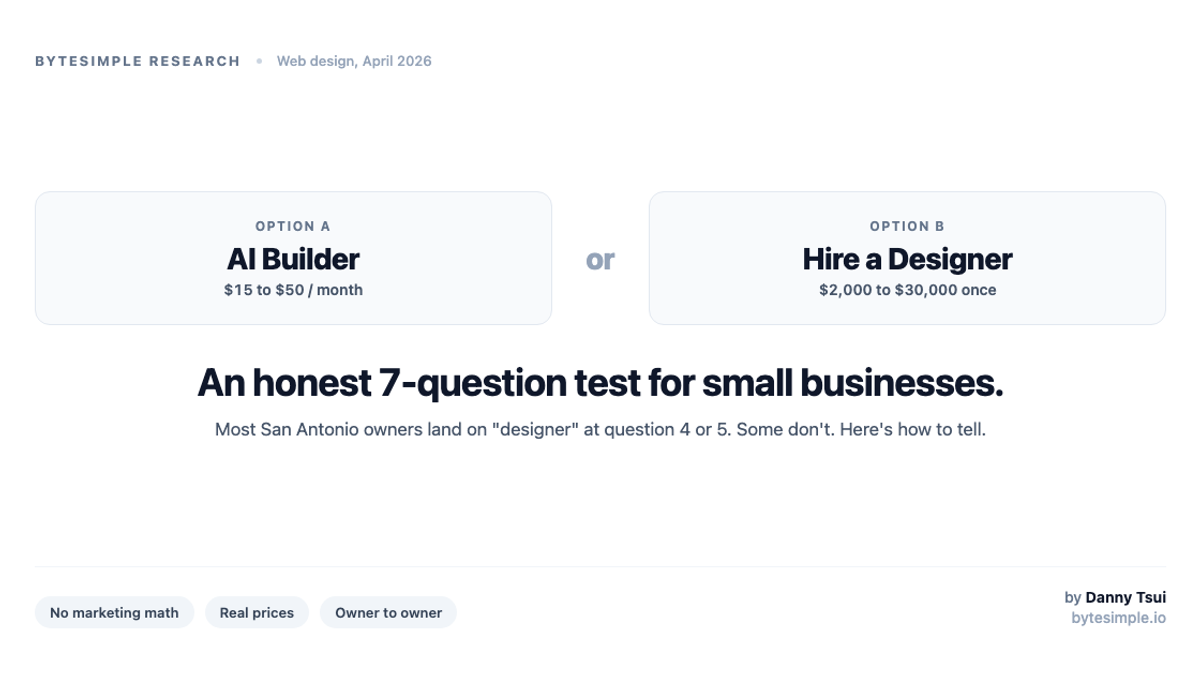
TL;DR
- AI website builders (Wix AI, Squarespace, Framer AI, Durable) are genuinely good in 2026 for simple brochure sites, and I'll tell you to use them when that's the right call.
- They break hard when you need real SEO work, custom integrations, booking flows, or content architecture that scales past 20 pages.
- Hiring a designer is a waste of money for a small brochure "about us" site. It pays off when the website has to actually bring in revenue.
- The decision tree below will tell you which side you're on in about 90 seconds.
What AI website builders actually do well in 2026
I'll say the quiet part out loud. AI builders have gotten good. If you asked me two years ago, I would have told you to avoid them. That answer has changed.
Here's what they genuinely do well right now:
Speed to a live site. You can describe your business to Wix AI or Durable and have a functioning small brochure site in under an hour. That used to take a designer a week.
Decent templates. Squarespace and Framer put out templates that look like they were designed by a human with taste. Ten years ago, template sites looked like template sites. Today, most visitors can't tell.
Mobile responsiveness out of the box. This used to be a real selling point for custom work. It isn't anymore. The builders handle it.
Basic SEO plumbing. Meta titles, meta descriptions, alt text fields, sitemap generation. It's all there. You still have to fill it in correctly, but the infrastructure works.
Hosting, SSL, backups. All included. No surprise invoices from a dev who forgot to renew a domain.
If you're a solo consultant, a baker running a side business, a photographer, or any small business that mostly needs a digital business card with a contact form, an AI builder at $15 to $50 a month is honestly the right answer. I will tell you that to your face.
Where AI website builders break
This is where the pitch gets real. AI builders break in predictable ways, and most of the time you don't find out until you're six months in and your business has outgrown the tool.
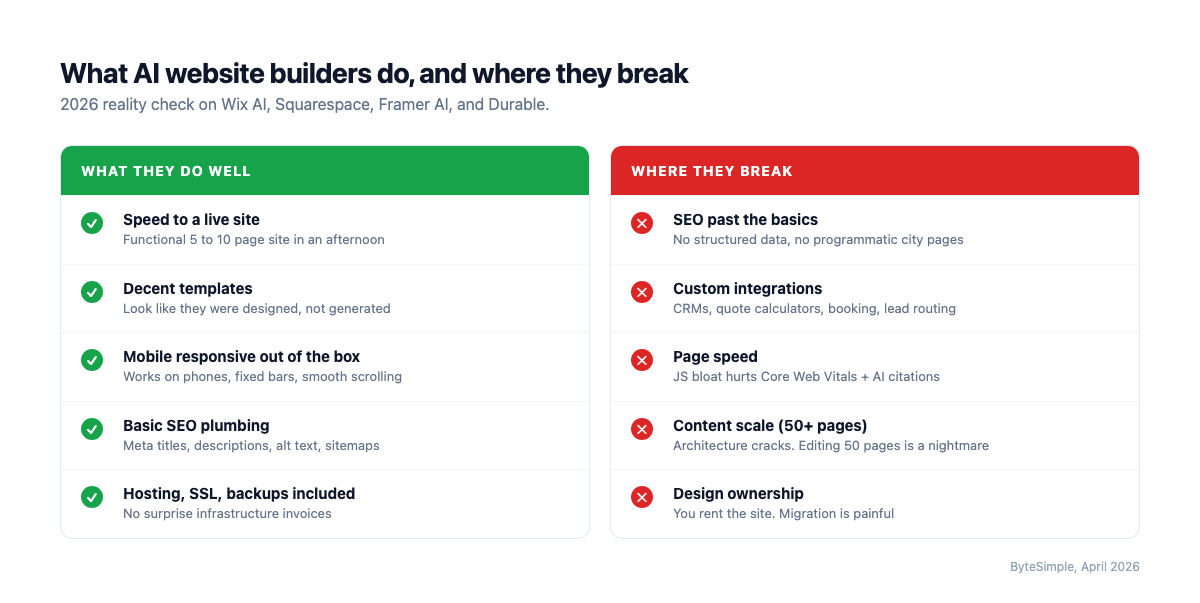
SEO past the basics. You can fill in a meta description. You cannot easily add structured data for services, locations, or reviews. You cannot control crawl budget. You cannot write custom schema for a specific service area. On a recent custom Next.js build for an HVAC client, we shipped LocalBusiness schema, Person schema for the owner, and FAQPage schema across service pages. None of that is easy on a drag and drop builder.
Content architecture at scale. A builder is great at 5 pages. It's workable at 15. At 50, it becomes a maintenance nightmare. If your SEO plan calls for a page per city, per service, or per neighborhood (and for a local San Antonio business, it often does), the builder falls over.
Custom integrations. CRMs, booking systems, payment logic, quote calculators, lead routing. You can duct tape most of this with Zapier. You cannot build a clean, native experience.
Page speed. AI builders load a pile of JavaScript to make the drag and drop editor work. That same JavaScript ships to your visitors. Core Web Vitals suffer. Google notices.
Design ownership. You rent the site. You don't own it. Try migrating a Wix site to a different platform in 2026 and see how fun that is. (Spoiler: you're rebuilding from scratch.)
Content management for owners who aren't technical. This one surprises people. Builders look easy in a demo. Six months later, your employee trying to update a blog post is calling you at 9pm because the editor broke.
When hiring a designer is a waste of money
I'll turn down this work, and I have. Here's when you should not pay a designer:
- You need a simple brochure site, under 10 pages, no blog, no booking.
- You have a budget under $1,500 for the whole project.
- You don't have real content yet, and you're hoping the designer will "figure out the messaging."
- You're early and testing whether the business idea works.
- You're a personal brand with no commerce or lead capture planned.
In any of those cases, open Squarespace, pick a template, and spend a weekend on it. You'll save four thousand dollars and end up with roughly the same outcome.
When hiring a designer pays off
Here's the other side. Paying for custom work is worth it when:
- Your website has to generate leads or sales, and you can measure that.
- You have a real SEO strategy and you need the technical foundation to support it.
- You need custom functionality (booking, quoting, routing, multiple locations).
- You're in a competitive local market and you need to beat incumbents who already rank.
- You have a content plan with more than 20 pages.
- You want the site to be an asset you own, not a subscription you rent.
For a local HVAC client I work with, a Wix site would have capped their SEO ceiling. We built them on Next.js and Sanity CMS so every service area, every FAQ, and every schema block could be controlled, indexed, and scaled. That's not a design preference. That's a revenue decision.
The decision tree
Run through these in order. Stop at the first "yes."
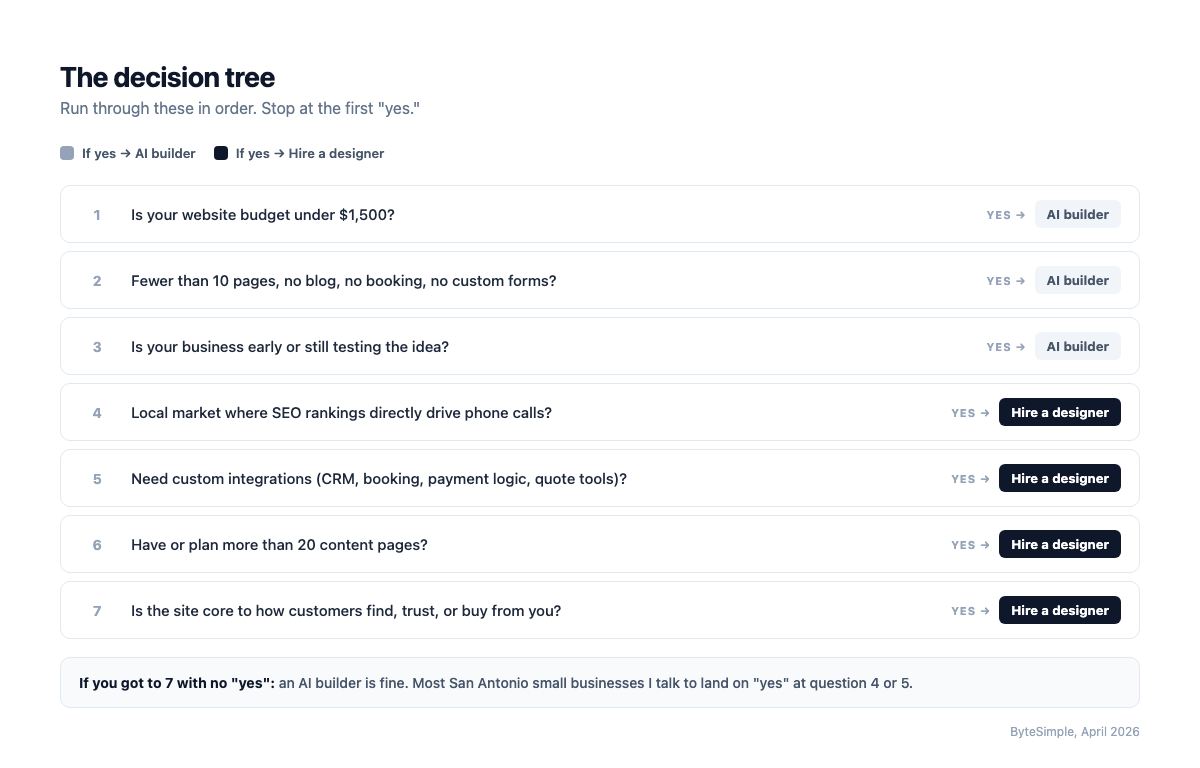
1. Is your website budget under $1,500? Yes: Use an AI builder. Done. Don't talk to a designer. No: Keep going.
2. Do you need fewer than 10 pages, with no blog, no booking, no custom forms? Yes: Use an AI builder. You'll be fine. No: Keep going.
3. Is your business early or still testing the idea? Yes: Use an AI builder. Validate first, invest later. No: Keep going.
4. Do you compete in a local market where SEO rankings directly drive phone calls? Yes: Hire a designer who understands SEO. A builder will cap your ceiling. No: Keep going.
5. Do you need custom integrations (CRM, booking, payment logic, quote tools)? Yes: Hire a designer. Builders can't do this cleanly. No: Keep going.
6. Do you have (or plan) more than 20 content pages? Yes: Hire a designer with a real CMS behind the site. No: An AI builder is probably fine.
7. Is the site core to how customers find, trust, or buy from you? Yes: Hire a designer. This is an asset, not a cost. No: Use an AI builder.
Most San Antonio small businesses I talk to land on "yes" at question 4 or 5. That's not me selling. That's just what local service businesses actually need.
Real examples from clients I've built for
HVAC company, custom Next.js + Sanity CMS. San Antonio. They serve 26 cities across South Texas. Their SEO plan calls for dedicated service area pages, FAQ schema, and llms.txt for AI search visibility. An AI builder could not support any of that. We built them a custom Next.js site with a Sanity backend so the owner can update content without touching code, and I can ship structured data, performance optimizations, and AI search infrastructure when the plan calls for it. This site pays for itself every time it ranks a service area.
Retail hat bar, Shopify (not custom). Custom hats made inside a San Antonio shopping center. They needed product commerce, booking for hat making experiences, and inventory sync. Shopify does all of that natively and cheaply. Building a custom ecommerce platform would have been throwing money away. I helped them pick a theme, added LocalBusiness and Organization schema, and fixed their meta structure. That's the right answer for them. Not every client needs custom.
Youth sports program, custom Next.js. They had no website, no Google Business Profile, and no sign up path when we started. Building them custom meant I could wire the lead flow, blog architecture, and SEO foundation in one pass. They're still early, and the investment only makes sense because the business is set up to grow into it.
Three clients. Three different answers. Shopify, custom Next.js, custom Next.js. The tool follows the strategy. Not the other way around.
The honest middle ground: start on a builder, migrate later
This is the path I recommend most often to businesses in their early stages, and it's the one most agencies won't tell you about because it doesn't sell a $10K engagement.
Start on Squarespace or Wix for year one. Validate the business. Get your first 50 customers. Figure out what your site actually needs.
Migrate to custom when the revenue supports it. Usually that's when SEO becomes your main channel, or when custom functionality becomes a bottleneck.
Here's what to avoid in that plan:
- Don't build 80 pages on the builder before you migrate. Migration cost scales with page count. Keep it lean.
- Don't let the builder hold your content hostage. Write your blog posts in Notion or Google Docs first, paste into the builder second. That way you can port them out without copying and pasting from a browser.
- Don't buy a premium template you can't take with you. The template dies when you leave the platform.
- Don't skip schema and SEO basics in year one just because "we'll fix it on migration." Bad habits compound. Set up Google Business Profile, get reviews, and keep your NAP consistent from day one.
Done right, the migration from builder to custom takes two weeks, not two months.
Price reality check
Here's what things actually cost in San Antonio in 2026. No marketing math, real numbers.
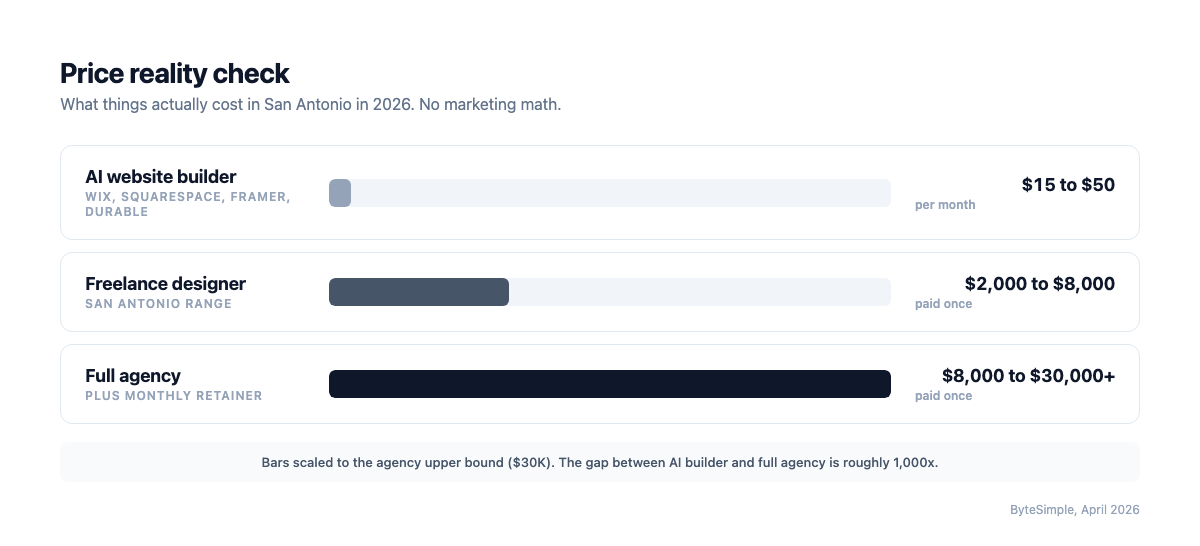
AI website builder. $15 to $50 per month. That's Wix, Squarespace, Framer, Durable. Includes hosting, SSL, templates, basic SEO fields. You build it yourself. Time investment: a weekend for a basic site, two weekends for a good one.
Freelance designer. $2,000 to $8,000, paid once. Most local freelancers in San Antonio land in the $3K to $5K range for a 10 page site. You get a real designer, a real build, and usually no ongoing SEO or maintenance unless you negotiate it in.
Full agency. $8,000 to $30,000+, paid once, plus monthly retainers. Bigger agencies charge for account management, project management, and overhead you don't see. The site isn't necessarily better. The bill is.
Where I land. I quote per scope after a 15 minute discovery call. Most small business builds fall in the freelance range above. Retainers (SEO plus site maintenance) start at $1,500 per month with no contract. I'll tell you straight if your project needs a bigger budget, or if an AI builder is actually the right answer for where you are today.
Be skeptical of any quote that skips the discovery conversation. If a designer quotes you $5K before they understand what the site needs to do, they're guessing. So are you.
Free 5-minute AI Visibility Check
Want to know if your business shows up when someone asks ChatGPT, Google AI Overviews, or Perplexity for a recommendation in your industry? I'll run a quick check and send you a plain English breakdown. No pitch, no contract, no sales call unless you ask for one.
Get Your Free AI Visibility Check →
Danny Tsui runs ByteSimple, a web design and SEO shop in San Antonio. He works directly with local businesses like HVAC companies, boutiques, and clinics. No contracts, no account managers. Learn more about ByteSimple →
See if your business shows up in ChatGPT
If you're running a home services business and you've never tested what AI says about you, here's an easy way to find out. I run a free AI Visibility Check by hand for HVAC, plumbing, electrical, and roofing owners. ChatGPT, Perplexity, Google AI Overviews, and Bing Copilot, all queried with what your customer would actually ask. PDF back in your inbox within 48 hours.
No automated dashboard, no signup tax, no upsell sequence. Get your free AI Visibility Check and see exactly where you stand.